


For something millions of women do every single year, coming off hormonal birth control is shockingly under-discussed. We talk endlessly about going on the pill — the appointment, the prescription, the careful reminders to take it at the same time each day. But the day you decide to stop? Most women are handed very little guidance and a whole lot of uncertainty. Will my period come back right away? Why does my skin look different? Is this mood swing the pill leaving my system, or just a bad week? And the big one that whispers in the back of your mind at 2 a.m.: is my body okay?
If you’re reading this, you may be standing at exactly that threshold — pill pack in hand, wondering what the next few months will look like. Take a breath. Coming off hormonal birth control is one of the most natural transitions your body can make, and for the overwhelming majority of women, it goes smoothly. But “smoothly” doesn’t mean “instantly,” and it certainly doesn’t mean “without surprises.” Your body has been running on a carefully calibrated hormonal script for months or years, and now it’s being asked to write its own again. That hand-off takes time, attention, and a little patience.
A woman holding a birth control pill pack, thoughtful
This guide is the conversation you wish your doctor had time for. We’re going to walk through everything — why women come off the pill in the first place, how hormonal contraception actually works, the crucial difference between a withdrawal bleed and a real period, the famous “post-pill adjustment” and its myths, a month-by-month map of what the first half-year can look like, what a genuinely healthy natural cycle looks like once it returns, the deep nutrition and lifestyle support that smooths the whole thing, and exactly why this is the single most important window in your reproductive life to start tracking what your body is doing. By the end, you’ll feel less like a passenger and more like the person holding the map.
Let’s get into it.
Why Women Come Off the Pill in the First Place
There’s no single reason, and there’s certainly no wrong one. The decision to stop hormonal birth control is deeply personal, and understanding your “why” actually helps you set expectations for what comes next. Here are the big ones.
Trying to Conceive (TTC)
The most obvious and joyful reason. You’re ready — or getting ready — to start a family, and the pill is the first thing that has to go. The good news, which we’ll return to in detail, is that fertility after the pill returns faster than the old wives’ tales suggest. There’s no need to “clear it out of your system” for months before trying. But understanding your returning cycle — when you actually ovulate again — becomes mission-critical the moment conception is the goal.
Side Effects You’re Done Tolerating
For some women, the pill is a quiet, decade-long companion with no complaints. For others, it’s a long negotiation with side effects they’ve learned to live with: low libido, persistent low mood or anxiety, headaches, breast tenderness, nausea, weight changes, or simply a vague, hard-to-name sense of not feeling like themselves. There’s a growing cultural permission — and rightly so — for women to say, “I want to know what I feel like without this,” and to find out.
Wanting Your Natural Cycle Back
This is increasingly the reason, especially among women in their late twenties and thirties. There’s a real, valid desire to reconnect with the body’s own rhythm — to experience a true menstrual cycle with its natural hormonal ebb and flow, its phases of energy and rest, its built-in feedback about overall health. The menstrual cycle is sometimes called the “fifth vital sign” for a reason: a healthy, regular natural cycle tells you a great deal about thyroid function, stress, nutrition, and metabolic health. On the pill, that signal is muted. Many women simply want it back.
Health Reasons and Life Changes
Sometimes it’s medical: a new diagnosis, a change in migraine pattern, blood-pressure concerns, a family history that makes a doctor recommend switching methods. Sometimes it’s situational — a relationship change, turning a certain age, wanting to move to a non-hormonal method like a copper IUD or fertility-awareness-based methods. And sometimes it’s philosophical: a broader shift toward a more “natural” lifestyle, fewer synthetic inputs, more body literacy.
The Quiet Reason Nobody Names: You Just Want to Feel Like You
There’s one more reason worth naming, because so many women feel it but rarely say it out loud. After years on a steady hormonal baseline, some women describe a low-grade sense of emotional flatness — not depression exactly, but a muting of the highs and lows, a slight dimming of desire, motivation, or aliveness. It’s hard to prove and harder to articulate to a busy doctor, and it can feel almost ungrateful to complain about a medication that worked perfectly well as contraception. But “I want to meet myself without this” is a completely legitimate reason to stop. You don’t owe anyone a dramatic medical justification. Curiosity about your own body is reason enough.
Whatever brought you here, the path forward is the same: understand what’s happening, give your body grace, and pay attention. Resources like vyvecare exist precisely because so many women reach this crossroads with more questions than answers, and deserve clear, reassuring information rather than panic-inducing forum threads.
How Hormonal Birth Control Actually Works
To understand what happens when you stop, you first have to understand what the pill has been doing. And here’s the thing most of us were never properly taught: hormonal birth control doesn’t regulate your natural cycle. It replaces it.
Your Natural Cycle, In Brief
Left to its own devices, your body runs a beautiful feedback loop. Your brain — specifically the hypothalamus and pituitary gland — sends out hormonal signals (FSH and LH) that tell your ovaries to mature an egg. As that egg develops, your ovaries produce rising estrogen, which thickens the uterine lining and creates the fertile, energetic feeling many women notice in the first half of their cycle. Around the midpoint, a surge of LH triggers ovulation — the release of the egg. After ovulation, the now-empty follicle produces progesterone, the calming, grounding hormone that stabilizes the uterine lining and prepares it for a possible pregnancy. If no pregnancy occurs, estrogen and progesterone fall, the lining sheds, and you get your period. Then the whole elegant conversation begins again.
That entire loop — brain talking to ovaries, ovaries talking back, ovulation at the center — is your natural cycle. It’s often called the HPO axis, short for hypothalamic-pituitary-ovarian axis, and it’s worth knowing that name, because the whole story of coming off the pill is really the story of that axis waking back up and starting to talk again.
What the Pill Does Instead
Combined hormonal contraceptives (the most common pills) contain synthetic estrogen and progestin. Progestin-only pills, the mini-pill, contain just the latter. Either way, the core job is the same: to keep steady levels of synthetic hormones in your bloodstream that suppress that brain-to-ovary conversation.
When your brain detects consistent hormone levels, it concludes there’s no need to send the “mature an egg” signal. So in most cases, ovulation simply doesn’t happen. No LH surge, no egg released, no natural progesterone production. The synthetic hormones also thicken cervical mucus (making it hostile to sperm) and thin the uterine lining (making implantation unlikely). That’s the contraceptive triple-lock: no egg, no easy passage for sperm, no welcoming lining.
Here’s the crucial implication, and it’s the one almost nobody explains clearly: on the pill, you are not having a natural menstrual cycle at all. You’re not ovulating. You’re running on a flat, externally-supplied hormonal baseline. Which leads us directly to one of the most important — and most misunderstood — concepts of the entire post-pill conversation.
A Quick Word on Different Methods
Not all hormonal contraception leaves the body at the same pace, and it’s worth knowing roughly where yours sits. The combined pill and the progestin-only pill clear quickly — their hormones are processed and gone within days of your last dose, which is why ovulation can return so fast. The hormonal IUD, the implant, and the vaginal ring work locally or are removed in a single moment, and fertility typically returns soon after removal. The one genuine exception is the contraceptive injection (the shot): it’s designed to be long-acting, and for some women it can take several months — occasionally up to a year — for normal cycles to resume after the last injection. None of this is cause for alarm; it simply means the “timeline” you should expect depends partly on which method you’re leaving. If you’re coming off the shot specifically, build in extra patience and don’t compare your timeline to a friend who stopped the pill.
What “Post-Pill” Really Means: The Withdrawal Bleed vs. a Real Period
If you take the pill, you’ve almost certainly had a monthly bleed during your placebo week (or your pill-free week). Most women call this their “period.” It is not.
The Withdrawal Bleed
That monthly bleed on the pill is a withdrawal bleed — your uterine lining shedding in response to the sudden drop in synthetic hormones when you hit the placebo pills or take a break. It looks like a period and shows up roughly monthly, which is exactly why it was designed that way. When the pill was developed, that monthly “reassurance bleed” was deliberately built in, partly to feel familiar and natural to users. But physiologically, it’s a reaction to dropping synthetic hormones — not the grand finale of a real ovulatory cycle.
This is why a withdrawal bleed is often lighter, more predictable, and less crampy than many women’s natural periods. There’s been no ovulation, no natural progesterone rise and fall, no full hormonal arc behind it.
A Real Period
A true menstrual period is the bleed that comes after ovulation has occurred and the resulting hormonal cascade has run its course. It’s the closing chapter of a complete cycle: egg matured, ovulation happened, progesterone rose and then fell, and the lining sheds. A real period carries information — about whether you ovulated, about your hormone balance, about your overall health.
Why This Matters When You Stop
Once you stop the pill, that monthly withdrawal bleed disappears, because there are no longer synthetic hormones to withdraw from. What you’re waiting for now is your first true period — the one that follows your body restarting ovulation on its own.
And this is the source of so much confusion. Many women stop the pill, bleed a few days later (that’s the final withdrawal bleed), and then assume their cycle is “back to normal.” Then weeks pass with nothing, and panic sets in. But that first bleed was just the pill leaving. The real test is whether and when your body starts ovulating again — and the period that follows that is your true return to natural cycling. Knowing the difference is the difference between needless anxiety and informed patience. It’s also a perfect example of why tracking from day one is so valuable, something we’ll build out fully later. (A clear, calm explainer on this exact distinction is one of the things a good best period tracker resource will spell out for you, instead of leaving you to guess.)
The Post-Pill Adjustment: What Actually Happens to Your Body
Here’s the honest truth: there is no single, universal “post-pill experience.” Some women stop, ovulate two weeks later, and feel completely themselves within a cycle or two. Others go through a few months of irregular timing, skin changes, and mood shifts before settling. Both are normal. Your experience depends on your age, your unique hormonal makeup, what your cycles were like before you went on the pill, how long you were on it, and your overall health.
That said, there are common patterns. Let’s walk through them so nothing catches you off guard.
How Long It Takes for Cycles to Regulate
For most women, ovulation resumes within a few weeks to a couple of months after stopping. A frequently cited general pattern is that the majority of women have their cycle return within about three months, and the large majority within six. Your first real period might arrive anywhere from a few weeks to a couple of months after that final withdrawal bleed.
It’s also completely normal for the first few natural cycles to be irregular. Your body is essentially rebooting a complex system. Early post-pill cycles can be shorter or longer than they’ll eventually settle into, ovulation timing can wander, and flow can vary. Think of it like an orchestra tuning up: the instruments are all there, they just need a little time to find the same key again. Give it three to six months before judging what your “real” cycle looks like.
A Month-by-Month Map of the First Six Months
No two women follow the exact same timeline, but a rough map helps enormously — not as a prediction to hold yourself to, but as a frame of reference so each stage feels expected rather than alarming. Here’s a gentle, generalized version of how the first half-year often unfolds.
Weeks 1 to 2: the final withdrawal bleed. Within a few days of your last active pill, you’ll usually get one more bleed. This is the pill leaving, not a true period. Many women feel pretty normal here — the synthetic hormones are still washing out, so any dramatic shifts haven’t really started yet. This is the ideal moment to begin tracking, because you’re capturing your baseline before the changes arrive.
Weeks 3 to 6: the quiet in-between. After that withdrawal bleed, there’s often a stretch of nothing — no bleeding, and possibly no obvious symptoms. This is frequently where anxiety creeps in, because it can feel like nothing is happening. In reality, a lot is happening invisibly: your HPO axis is waking up, FSH and LH are starting to pulse again, and your ovaries are beginning to think about maturing a follicle. For many women, a first ovulation occurs somewhere in this window, even if they don’t notice it. Watch for the first signs of fertile cervical mucus — clear, slippery, stretchy — as the earliest hint that ovulation is coming back online.
Month 1 to 2: your first true period. When ovulation does happen, a real period follows roughly two weeks later. This first natural period can feel different from your pill bleeds — sometimes heavier, crampier, or differently timed, because there’s a full hormonal arc behind it now. Some women are pleasantly surprised; others find it more intense than expected. Either way, it’s a genuinely good sign: it usually means you ovulated.
Months 2 to 4: the wobble. This is often the messiest stretch, and the one that worries women most. Cycles may run short, then long. Ovulation timing wanders. Skin may flare. Mood may swing as the natural premenstrual dip reasserts itself for the first time in years. Hair shedding, if it’s going to happen, often shows up around here. None of this means something is wrong — it’s the system recalibrating. The single most useful thing you can do is keep logging, because the wobble is precisely the data that later reveals your settling pattern.
Months 4 to 6: settling in. For most women, cycles begin to find a rhythm by this point. Lengths cluster into a more predictable range, ovulation becomes more reliable, and the dramatic skin and mood shifts ease as hormones rebalance. By the end of month six, many women have a clear picture of their “real” cycle — the one that was waiting underneath the pill all along. If you’re still wildly irregular at this point, that’s the natural cue to check in with a provider, not because something’s broken, but because it’s worth a proper look.
Keep in mind this is a generalized map. Plenty of women move faster, a few move slower, and women coming off the injection in particular should expect a longer runway. Use it as a reassuring backdrop, not a deadline.
Post-Pill Amenorrhea
Sometimes the period doesn’t come back as quickly as expected. When you go several months without a period after stopping, it’s sometimes called post-pill amenorrhea. In most cases, this simply means your body is taking a bit longer than average to restart its own hormonal rhythm — particularly if your cycles were irregular before you ever started the pill.
It’s worth knowing that the pill doesn’t cause long-term absence of periods; rather, it can mask underlying conditions that were always there. If your cycles were irregular pre-pill, they may return to that pattern, and the pill was simply hiding it. If you go three months or more without a period after stopping, it’s a sensible time to check in with a healthcare provider — not because something is necessarily wrong, but because it’s worth ruling out things like thyroid issues, low body weight, high stress, or polycystic ovary syndrome.
A few common, very fixable contributors to a slow return are worth knowing about, because they’re more frequent than the scarier diagnoses. Under-eating or rapid weight loss can signal scarcity to the body, which deprioritizes ovulation. Over-exercising, especially endurance training combined with low food intake, does the same. Chronic stress keeps cortisol elevated, which interferes with the brain’s reproductive signaling. And low body fat can leave you without enough raw material to make sufficient estrogen. The encouraging flip side is that all of these respond beautifully to gentle correction — more nourishment, more rest, less pressure — which is exactly why the lifestyle section below matters so much during this window.
The Skin, Hair, Mood, and Libido Rebound
This is the part that surprises women most, so let’s be candid about it and go deeper than the usual one-liners.
Acne. Many combined pills are mildly anti-androgenic — they suppress the male-pattern hormones that drive oil production and breakouts. When you stop, those androgens can rebound, and some women experience a flare of hormonal acne, typically along the jaw, chin, and lower cheeks, that peaks somewhere around months two to four. For most, this settles as hormones rebalance over three to six months, though for some it takes a little longer. It’s frustrating, especially if you went on the pill for clear skin in the first place, but it’s usually temporary. The internal levers that genuinely help are the unglamorous ones: stabilizing blood sugar (so insulin doesn’t drive more androgen activity), getting enough zinc and omega-3s, sleeping well, and managing stress. Be wary of aggressive new skincare bought in panic — gentle consistency tends to beat reactive overhauls. If a flare is severe, persistent past six months, or genuinely distressing, a dermatologist or gynecologist can help, and your tracked data showing exactly when it started is useful to them.
Hair. Two distinct things can happen here, and conflating them causes unnecessary worry. The first is increased shedding, often noticed two to four months after stopping. This is usually a temporary shift related to the change in hormones (a mild, self-resolving form of the same kind of shedding that can follow any hormonal event), and the hair typically recovers over the following months. The second is a change in texture or oiliness as natural androgens return — some women find their hair gets a little oilier or curlier or simply different. Adequate protein, iron, zinc, and biotin-rich whole foods support hair through the transition. If shedding is dramatic, patchy, or still worsening past six months, that’s worth a check, partly to rule out low iron or thyroid issues, which are common and very treatable.
Mood. This one cuts both ways, beautifully. Some women who felt flattened, anxious, or low on the pill describe a genuine lifting once their natural hormones return — more emotional range, more spark, a return of feeling “like themselves.” Others experience a transitional wobble as hormones fluctuate before settling, including some PMS they didn’t have on the steady pill baseline. Reintroducing the natural progesterone rise and fall means reintroducing the natural premenstrual dip too — that low, tender, slightly raw feeling in the days before a period that the flat pill baseline may have smoothed away entirely. Knowing it’s coming makes it far easier to ride. If you can see on a tracker that your mood reliably dips on, say, cycle days 24 to 28, you can plan kindness into those days rather than being ambushed by them. For a small number of women, mood changes after stopping are significant and persistent rather than cyclical — if that’s you, please don’t tough it out alone; speak to a provider.
Libido. Frequently a pleasant surprise, and worth dwelling on because it’s so under-discussed. The pill can dampen libido for some women through a few mechanisms — by suppressing the natural testosterone that contributes to desire, and by raising a protein that binds up free testosterone. When you stop, that natural testosterone and its effects can return, and many women report a noticeable rebound in desire, sensitivity, and spontaneous interest. It’s one of the more commonly cited upsides of coming off the pill. Like everything else here it can take a cycle or two to show up, and it often tracks with your cycle phase — many women notice desire peaking around ovulation, which is your body’s design working exactly as intended.
The “Post-Pill PCOS” Myth vs. Reality
You’ve probably seen the alarming headlines: “The pill gave me PCOS.” Let’s set the record straight, because this myth causes enormous, unnecessary anxiety.
The pill does not cause PCOS. Polycystic ovary syndrome is a hormonal and metabolic condition with genetic and lifestyle components, and it develops over a lifetime — not from a course of contraceptive pills. Here’s what’s really happening in those stories: PCOS is often present before a woman goes on the pill, but its hallmark symptoms (irregular cycles, acne, excess hair growth) are masked by the steady hormones the pill provides. When she stops, those underlying symptoms surface again — and because they appear right after stopping, the pill gets blamed.
In other words, the pill didn’t give her PCOS. It hid it, and stopping revealed it. This is actually a really important reframe, because it means that if you do find yourself with irregular cycles and androgen symptoms after stopping, the right response isn’t “the pill broke me” — it’s “let me get properly evaluated for a condition I may have always had, so I can manage it well.” That’s empowering, not frightening. And it’s another reason tracking matters: clear records of your post-pill cycles are exactly what a doctor needs to make an accurate diagnosis instead of a guess.
There’s a parallel worth mentioning, because it follows the same logic: endometriosis and heavy or painful periods can also be masked by the pill. Many women are prescribed the pill in their teens precisely because it tames heavy, painful bleeding — and when they come off it years later, that underlying pain can return. Again, the pill didn’t cause it; it managed it. If debilitating period pain reappears after stopping, that’s not your body falling apart, it’s an underlying issue becoming visible again, and it deserves proper evaluation rather than silent endurance.
What a Healthy Natural Cycle Looks Like Once It Returns
So your body has done its thing, ovulation has resumed, and your real cycles are settling in. What are you actually aiming for? What does “normal” look like? It helps enormously to have a mental picture, so you can recognize health when you see it — and notice when something might be worth a conversation with your doctor.
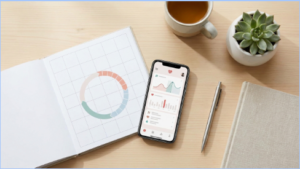
A cycle calendar and phone for tracking after the pill
Cycle Length
A healthy natural cycle typically runs anywhere from about 21 to 35 days, counting from the first day of one period to the first day of the next. The textbook “28-day cycle” is an average, not a rule — plenty of perfectly healthy women run consistently shorter or longer. What matters more than the exact number is relative regularity: your cycles landing in a reasonably predictable range, rather than swinging wildly from 24 days to 45 days month to month once you’re past the initial post-pill settling period.
It’s also useful to understand that a cycle has two halves with very different personalities. The first half — from your period to ovulation — is the variable one; it can stretch or shrink depending on stress, illness, travel, or simply how long your body takes to mature a follicle that month. The second half — from ovulation to your next period, called the luteal phase — is usually more fixed, often around 12 to 14 days. This is why a “late period” is frequently not a late period at all, but late ovulation: once you ovulate, the countdown to bleeding is fairly consistent. Understanding this single fact dissolves a huge amount of post-pill panic, because it explains why your cycle length can vary while still being completely healthy.
The Four Phases
A complete natural cycle moves through four phases, and getting to know them is genuinely life-enhancing:
- Menstrual phase (the period itself): hormones are at their lowest, the lining sheds. Energy is often lower; rest is your friend.
- Follicular phase (after your period, before ovulation): estrogen rises, energy and mood typically climb, skin often looks its best, and you may feel more outgoing and motivated.
- Ovulation (mid-cycle): the estrogen peak and LH surge release the egg. Many women feel their most confident and social, libido often peaks, and there’s a roughly 24-hour window where the egg can be fertilized.
- Luteal phase (after ovulation, before the next period): progesterone rises to soothe and stabilize, then falls if there’s no pregnancy. The back end of this phase is where PMS lives — the energy dip, the cravings, the need for quiet.
Living in tune with these phases — sometimes called “cycle syncing” — can transform how you work, eat, train, and rest. But you can only sync to a rhythm you can see, which is the whole case for tracking.
Signs of a Healthy Period and Ovulation
A reassuring, healthy natural cycle often includes:
- Predictable timing within your personal range.
- A period that lasts roughly 3 to 7 days, with manageable flow.
- Cramps that are noticeable but not debilitating — discomfort you can function through, not pain that puts you in bed.
- Signs of ovulation you can learn to spot: a change in cervical mucus to a clear, stretchy, egg-white consistency around mid-cycle; a slight rise in basal body temperature after ovulation; sometimes a twinge of one-sided “mittelschmerz” pain.
- A premenstrual phase you can predict and prepare for, rather than one that blindsides you.
Knowing what healthy looks like is your baseline. Anything that consistently falls far outside it — periods that vanish, flow that’s extremely heavy, pain that’s disabling, cycles that never settle — is worth a professional conversation, and we’ll cover that below.
Your Cycle as a Vital Sign
It’s worth pausing on why all this matters beyond fertility. A healthy, ovulatory cycle isn’t only about whether you can get pregnant — it’s a window into your whole-body health. Ovulation produces progesterone, and progesterone does far more than prepare the uterus; it supports bone health, mood, sleep, and metabolic balance. Regular ovulatory cycles are, in a real sense, a sign that your body feels safe, well-fed, and well-regulated enough to reproduce — which is a pretty good proxy for overall wellness. That’s why leading health bodies have increasingly framed the menstrual cycle as a vital sign, alongside heart rate and blood pressure. When you come off the pill and your natural cycle returns, you’re not just regaining fertility; you’re regaining a continuous, free, monthly health report — if you take the trouble to read it.
Why Tracking Is Essential the Moment You Stop the Pill
If you take only one practical action from this entire article, let it be this: start tracking your cycle the day you stop the pill — ideally even before.
Here’s why this window is so uniquely important. When you come off the pill, you are, in a very real sense, meeting your natural cycle for the first time — or for the first time in years. You don’t yet know your true cycle length. You don’t know when you ovulate. You don’t know your personal PMS pattern, your normal flow, your unique constellation of symptoms. All of that information is about to reveal itself, cycle by cycle, and if you’re not paying attention, it slips by ungathered.
Learning Your Real Cycle From Scratch
Every woman’s cycle is a fingerprint. The “28 days, ovulate on day 14” model is an average that describes almost no one exactly. By tracking your bleeding, your symptoms, and your fertile signs from the start, you build — over just a few months — an accurate, personal portrait of how your body works. That knowledge is power: it lets you plan, anticipate, and stop being surprised by your own physiology.
Spotting Ovulation Again
Remember, the headline event of coming off the pill is the return of ovulation. But ovulation is invisible unless you look for it. Tracking the telltale signs — cervical mucus changes, basal body temperature shifts, and the cycle patterns that surround them — lets you actually see the moment your fertility comes back online. If you’re trying to conceive, this is everything. If you’re avoiding pregnancy with non-hormonal methods, it’s equally essential. And even if neither applies, knowing you’re ovulating is a deeply reassuring sign that your hormonal system is healthy and working.
What’s Worth Tracking (and What You Can Ignore)
It’s easy to feel like tracking means logging everything obsessively. It doesn’t. A few high-value signals carry most of the information:
- Bleeding: start date, end date, and a rough sense of flow (light, medium, heavy). This alone gives you cycle length, which is the foundation of everything.
- Cervical mucus: the single most accessible real-time sign of approaching ovulation. As estrogen rises, mucus shifts from dry or sticky to creamy to clear, slippery, and stretchy like raw egg white. That egg-white quality is your fertile flag.
- Basal body temperature (BBT), if you want confirmation of ovulation: taken first thing on waking, it rises slightly after ovulation and stays up through the luteal phase. BBT confirms ovulation after the fact, which is brilliant for learning your pattern.
- Symptoms and mood: skin, energy, libido, cramps, headaches, sleep, mood. Logged over a few cycles, these reveal your personal premenstrual signature and how your transition is progressing.
You don’t need to track all of these forever. Many women go deep for the first few months to learn their pattern, then lighten up once their cycle settles. The point isn’t perfection — it’s enough consistent data to turn invisible physiology into a story you can read.
Knowing What’s Normal — For You
Tracking turns vague anxiety into concrete information. Instead of wondering “is this normal?” you’ll have data: “My cycles have been 29, 31, and 30 days — they’re settling.” Or: “I’ve had spotting mid-cycle three months running; I’ll mention it to my doctor.” You stop guessing. And if you ever do need medical help, you’ll walk in with a clear record instead of a shrug — which dramatically improves the quality of care you receive.
How a Modern Cycle App Fits In — The Vyve Approach
This is exactly the moment a thoughtful cycle-tracking app earns its place, and it’s where the Vyve app was built to shine. The post-pill transition is messy and individual — predictable calendar-math apps that assume a textbook 28-day cycle are nearly useless when your cycle is still finding itself. What you need is something that learns you.
Vyve uses AI predictions that adapt to your returning cycle rather than forcing you into a generic template. In those unpredictable first few months, that adaptive intelligence is the difference between an app that constantly “gets it wrong” and one that actually keeps pace with your changing body, refining its understanding with every cycle you log. As your real rhythm emerges, the predictions sharpen with it.
Beyond predictions, Vyve includes an AI Cycle Coach — guidance that meets you where you are in the transition, helping you interpret what you’re seeing and understand whether a given experience is part of the normal post-pill picture. Its symptom and mood tracking lets you log the very things that change most after stopping the pill — skin, mood, energy, libido, cramps — so patterns become visible instead of just felt. There’s even cycle-synced Food and Nutrition guidance designed to support your body through each phase, which is genuinely useful during a transition when hormone recovery benefits from targeted nourishment.
And because cycle data is some of the most intimate information you’ll ever record, Vyve is built privacy-first — your body’s story stays yours. For many women, that reassurance is non-negotiable. You can explore the Period Tracker App to see how this adaptive, supportive approach works in practice. The team behind it shares plenty of free, no-pressure education over at vyvecare too, so you can learn even before you download anything.
Lifestyle Support for the Post-Pill Transition
Your cycle doesn’t restart in a vacuum. It restarts inside you — your nutrition, your sleep, your stress levels, your daily life. The good news is that the same habits that support a healthy hormonal recovery are the habits that support a healthy life, full stop. None of this is about strict rules or expensive protocols. It’s about giving your body the raw materials and the calm conditions it needs to find its rhythm.
A gentle, non-medical note before we dive in: what follows is general wellness information, not personalized medical advice. Supplements in particular interact with individual health conditions and medications, so loop in a healthcare provider before starting anything new.
Nourishing whole foods to support hormone recovery

Nutrition: Feed the Hormone Factory
Hormones are built from the food you eat, so this is the most direct lever you have. Let’s go deeper than “eat healthy,” because the specifics genuinely matter during recovery.
- Don’t fear healthy fats. Cholesterol and fatty acids are literally the building blocks of sex hormones. Your body cannot manufacture estrogen and progesterone out of thin air — it needs raw material, and that material is fat. Avocados, olive oil, nuts, seeds, oily fish, and eggs give your body what it needs. Women who eat very low-fat diets sometimes struggle to restart robust cycles for exactly this reason. This is not the season for fat-phobia.
- Prioritize protein at each meal to support stable blood sugar — and stable blood sugar is one of the unsung heroes of hormonal balance. Big blood-sugar swings drive cortisol and insulin, and both disrupt the very brain-to-ovary signaling you’re trying to restart. Aim for a palm-sized portion of protein at each meal, and notice how much steadier your energy and mood feel when you do.
- Eat the rainbow of vegetables, especially leafy greens and cruciferous vegetables (broccoli, cauliflower, Brussels sprouts, kale). These cruciferous vegetables contain compounds that support the liver’s job of processing and clearing used hormones — an underrated part of keeping your hormonal house in order.
- Mind key micronutrients. Coming off the pill, many women focus on replenishing nutrients that long-term pill use may deplete. The commonly discussed ones are the B vitamins (especially B6, B12, and folate), magnesium, zinc, selenium, vitamin C, and sometimes vitamin E. Folate is especially worth front-loading if conception is anywhere on the horizon. A whole-foods, nutrient-dense diet refills the tank far more reliably than chasing single supplements.
- Iron and your blood. As real periods return, you start losing blood again — and iron with it. Women with heavy flow are particularly prone to running low on iron, which can quietly cause fatigue, hair shedding, and low mood that’s easy to misattribute to “post-pill blues.” Iron-rich foods (red meat, lentils, leafy greens, eaten alongside vitamin C for absorption) matter more now than they did on the pill.
- Support your gut and liver, since both are central to hormone metabolism. Your liver processes hormones, and your gut helps escort the used ones out of the body; if either is sluggish, hormones can recirculate in ways you don’t want. Fiber-rich foods, fermented foods (yogurt, kefir, sauerkraut, kimchi), and plenty of water do quiet, important work here.
- Don’t undereat. This deserves its own line. Chronically eating too little — whether from dieting, busyness, or appetite changes — is one of the most common reasons cycles fail to return. Your body reads scarcity as “now is not a safe time to reproduce” and downregulates ovulation accordingly. Adequate, consistent fuel is not indulgence during this window; it’s a prerequisite.
This is, incidentally, where Vyve’s cycle-synced Food and Nutrition feature becomes practical rather than theoretical — it translates “eat for your phase” into actual, doable suggestions that line up with where you are in your returning cycle. Loose phase-based eating can be lovely: leaning on iron and warming, mineral-rich foods during your period; lighter, fresh, energizing foods in your follicular and ovulatory phases; and complex carbs, magnesium-rich foods, and comforting nourishment in your luteal phase when cravings and the premenstrual dip arrive.
Sleep: The Hormonal Reset Button
Sleep is when your body does its hormonal housekeeping. Poor or insufficient sleep elevates cortisol and disrupts the delicate signaling involved in ovulation. Your reproductive hormones are deeply entangled with your circadian rhythm — the body’s internal clock — and that clock is set largely by sleep and light. Aim for a consistent sleep-wake schedule (the consistency matters as much as the hours), a genuinely dark room, morning daylight exposure to anchor your rhythm, and a wind-down routine that lets your nervous system downshift. During the post-pill transition especially, treat sleep as non-negotiable medicine — it’s free, and it’s powerful. Many women also notice that, as their natural cycle returns, sleep itself starts to vary across the cycle — often lighter in the late luteal phase — which is normal and another lovely thing to notice on a tracker.
Stress: The Ovulation Disruptor
Here’s a piece of physiology worth tattooing on your brain: chronic stress can directly suppress ovulation. Your body, sensing “danger,” can deprioritize reproduction — the same survival logic that downregulates cycles in times of famine or threat. The mechanism is real: sustained stress keeps cortisol elevated, and elevated cortisol interferes with the brain’s release of the reproductive signals that trigger ovulation. So managing stress isn’t a fluffy add-on during this transition — it’s central.
This doesn’t mean you need to overhaul your life or achieve some unattainable state of zen. It means building in small, regular nervous-system regulation: walks outside, breathwork, gentle movement, time away from screens, saying no to things that drain you, and protecting moments of genuine rest. Even a few minutes of slow breathing a day, done consistently, sends your body a steady signal of safety — and safety is precisely what an ovulating body needs to feel.
Many women find that the post-pill period naturally invites a broader season of self-reflection — a reconnection not just with their physical rhythm but with themselves. Some lean into journaling or meditation; others enjoy more reflective, intuitive practices. If that resonates with you, gentle tools like Raka Ai — an AI tarot and astrology companion — can be a lovely, low-stakes way to create space for introspection and check in with how you’re really feeling. There’s something quietly fitting about pairing the return of your natural cycle with a renewed attention to your inner world; the body’s rhythm and the inner life have always been more connected than modern life lets us notice.
Movement: Enough, But Not Too Much
Regular, moderate movement supports insulin sensitivity, mood, and circulation — all helpful for hormone balance. But be wary of overtraining, especially combined with under-eating, because that combination is one of the more common reasons cycles fail to return after stopping the pill. Your body needs to feel safe and well-fueled to ovulate, and punishing, depleting exercise sends the opposite message. Strength training, walking, yoga, pilates, swimming, and joyful movement you actually enjoy beat grinding yourself down in the gym.
You can even loosely align workout intensity with your cycle phases — leaning into intensity and heavier lifts in your follicular and ovulatory phases, when energy and strength tend to peak, and honoring gentler movement and rest in your luteal and menstrual phases, when your body is asking for recovery. This isn’t about rigid rules; it’s about working with your physiology instead of against it. Many women find that simply giving themselves permission to rest in the luteal and menstrual phases — rather than forcing the same intensity all month — improves both their training and their cycles.
Supplements: General Guidance Only
Many women in the post-pill window consider supplements to support the transition. Commonly discussed options include a quality prenatal or methylated multivitamin (especially if conception is on the horizon), magnesium for sleep and PMS, omega-3 fatty acids for skin and mood, vitamin D (which behaves almost like a hormone itself and is widely under-replete), and zinc for skin and hormone support. Some women explore B-complex vitamins to replenish what the pill may have depleted, and a few look into adaptogenic or cycle-supporting herbs. If you had heavy periods, iron may be worth testing for and addressing.
But — and this matters — supplements are individual. What helps one woman may be unnecessary or even unwise for another, and some interact with medications or existing conditions. Taking high doses of things you don’t need is not harmless. Treat the internet’s confident supplement advice with healthy skepticism, ignore anyone selling you a “post-pill detox protocol” (your liver detoxes you for free), and let a qualified provider help you decide what, if anything, you actually need — ideally guided by bloodwork rather than guesswork. Food first; supplements to fill genuine, identified gaps.
Coming Off the Pill to Conceive
If your reason for stopping is to start trying for a baby, this section is for you — and it comes with a big, reassuring headline: you do not need to “detox” from the pill before trying.
Fertility Returns Quickly
One of the most persistent and unhelpful myths is that you must wait several months — or “let the pill clear your system” — before trying to conceive. The reality is that fertility can return very soon after stopping, sometimes within the very first cycle. Many women ovulate within weeks. There’s no medical requirement to wait, and pregnancies conceived shortly after stopping the pill are not at higher risk because of recent pill use. If you’re ready, you’re ready.
In fact, there’s a small body of thought that the first cycle or two after stopping the pill may carry a slightly heightened chance of conceiving for some women, as the ovaries come back online with a little extra enthusiasm — though this is far from guaranteed and shouldn’t be counted on as either a plan or a worry. The honest, reassuring takeaway is simply that you can start trying as soon as you feel ready.
That said, two practical notes. First, conceiving in your very first post-pill cycle can make dating the pregnancy slightly trickier, since you may not yet know your natural cycle length and there’s no “last normal period” to count from in the usual way — but this is a minor logistics point that an early scan easily resolves, not a health concern. Second, while fertility returns fast, your individual cycle’s predictability may take a little time to settle, which is exactly why tracking becomes so valuable when you’re TTC.
Understanding the Fertile Window
When you’re trying to conceive, almost everything comes down to one concept: the fertile window. This is the handful of days in each cycle when intercourse can lead to pregnancy — roughly the five days before ovulation plus ovulation day itself. The reason it stretches before ovulation is that sperm can survive in fertile cervical mucus for several days, lying in wait for the egg. The egg itself, once released, is only viable for about 12 to 24 hours. So the strategy that works isn’t “have sex on ovulation day” — it’s “have sex in the days leading up to ovulation,” so that healthy sperm are already present when the egg arrives.
The catch, of course, is that you have to know when ovulation is coming — and coming off the pill, you’re meeting your ovulation timing fresh, with no reliable history to lean on. That’s why fertile-sign tracking is so powerful for conception: fertile cervical mucus and (for some) ovulation predictor kits give you a real-time heads-up that your fertile window is opening, while BBT confirms afterward that ovulation actually happened. Put those together over a couple of cycles and you go from guessing to genuinely understanding your own fertile pattern.
Tracking Is Your Best Friend When TTC
When you’re trying to conceive, the single most important thing to know is when you ovulate — because that defines your fertile window. Coming off the pill, you’re meeting your ovulation pattern fresh, so you can’t rely on assumptions. This is where dedicated cycle tracking earns its keep: by logging your fertile signs and letting an adaptive app like Vyve learn your returning rhythm, you can pinpoint your fertile window far more accurately than calendar guesswork. The AI Cycle Coach can help you understand the signs you’re seeing, and the adaptive predictions tighten with each cycle as your body settles into its groove. As you build a few months of data, those predictions become genuinely useful for timing — and far less stressful than charting everything by hand on a paper calendar.
A gentle note on the emotional side: trying to conceive can quietly turn into a pressure cooker, especially in the early months when your cycle is still settling. Try to hold the tracking lightly. Its job is to reduce anxiety by giving you clarity, not to become one more thing to obsess over. Most healthy couples take several months to conceive even with perfect timing — that’s completely normal and not a sign of a problem.
Preparing Your Body
The pre-conception window is also a natural time to lean into all the lifestyle support above — nutrition, sleep, stress management — and, importantly, to start a folic acid or prenatal supplement if you haven’t already, since it supports healthy early fetal development from the very beginning, often before you even know you’re pregnant. Many providers suggest starting this a few months before you begin trying. It’s also a good moment to look at alcohol, caffeine, and smoking, to make sure any chronic conditions are well-managed, and to bring your partner into the picture — sperm health matters just as much, and benefits from the same good-living basics. As always, that’s a conversation to have with your own doctor.
For deeper, ongoing reading as you navigate TTC, a well-curated resource like best period tracker can be a steady companion — and the educational content over at vyvecare is written with exactly this transition in mind.
When to See a Doctor
A gentle but important note: everything in this article is general information for education and reassurance — it is not medical advice, and it can’t account for your personal health history. Please treat your own healthcare provider as the final word on anything specific to you.
With that said, most of the post-pill journey is normal and self-resolving. But there are some signposts that genuinely merit a professional conversation. Reach out to a doctor, gynecologist, or qualified provider if:
- Your period hasn’t returned after about three months off the pill (post-pill amenorrhea worth investigating).
- Your cycles remain wildly irregular beyond the initial settling period of three to six months.
- You experience very heavy bleeding — soaking through protection rapidly, or passing large clots regularly.
- You have severe pain — cramps that disable you, or pain that’s new and intense.
- You notice significant symptoms like marked acne, excess hair growth, or other changes that point toward conditions like PCOS or thyroid issues, so you can be properly evaluated.
- You’ve been trying to conceive without success — generally around a year if you’re under 35, or six months if you’re 35 or older, though sooner if you have known cycle irregularities.
- You feel mood changes that worry you, or anything that simply doesn’t feel right.
- You experience bleeding between periods or after sex consistently, which is always worth getting checked.
None of these mean something is wrong — they mean it’s smart to check. And here’s the recurring theme: walking into that appointment with a few months of tracked cycle data turns a vague conversation into a productive one. Your provider can see patterns at a glance instead of relying on your best recollection. That’s tracking paying dividends exactly when it counts. It also helps to write down your specific questions before you go, and to note when your symptoms started relative to stopping the pill — context that’s easy to forget in a short appointment but genuinely useful to a clinician.
A confident relaxed woman smiling at home

Frequently Asked Questions
1. How long does it take for my period to come back after stopping the pill?
For most women, ovulation resumes within a few weeks to a couple of months, and a real period follows. A commonly cited general pattern is that the majority of women see their cycle return within about three months, and the large majority within six. Some bounce back in their very first cycle; others take a little longer, especially if their cycles were irregular before starting the pill. If three months pass with no period, it’s a sensible time to check in with a provider.
2. Is the bleed I get on the pill a real period?
No — that monthly bleed during your placebo week is a withdrawal bleed, your body’s reaction to the drop in synthetic hormones, not a true menstrual period. A real period follows ovulation and a full natural hormonal cycle. On the pill, you typically aren’t ovulating, so those bleeds, while reassuring and regular, aren’t the same physiological event as a natural period.
3. Will coming off the pill mess up my cycle permanently?
Almost never. The pill doesn’t cause long-term cycle damage. It may mask a pre-existing irregularity or condition that resurfaces when you stop, but it doesn’t create one. For the vast majority of women, cycles regulate within three to six months and settle into a healthy, predictable pattern.
4. Can the pill cause PCOS?
No. The pill does not cause polycystic ovary syndrome. PCOS is a hormonal and metabolic condition that develops over a lifetime and is often present before a woman ever starts the pill. The pill can hide its symptoms by providing steady hormones; when you stop, those underlying symptoms can reappear and get mistakenly blamed on the pill. If you suspect PCOS, get evaluated — and bring your tracked cycle data.
5. Why do I have acne after stopping the pill?
Many combined pills suppress the androgens that drive oil production and breakouts. When you stop, those hormones can rebound, sometimes causing a flare of hormonal acne (often along the jaw and chin) that peaks a couple of months in. For most women, this settles as hormones rebalance over three to six months. Supporting your skin from the inside — balanced nutrition, stable blood sugar, good sleep, stress management, adequate zinc and omega-3s — helps the transition.
6. How soon can I get pregnant after coming off the pill?
Very soon — sometimes in the first cycle. There’s no need to wait or “detox” before trying. Fertility can return rapidly, and pregnancies conceived shortly after stopping aren’t at higher risk because of recent pill use. If you’re ready to try, you can start right away. Tracking your cycle helps you identify your fertile window since you’re meeting your natural ovulation pattern fresh.
7. Do I need to “detox” or “cleanse” the pill out of my system before trying to conceive?
No. This is a persistent myth. The synthetic hormones clear from your body quickly after you stop. There’s no medical reason to wait months before trying, and no “detox protocol” is necessary — your liver and kidneys handle that automatically. The most useful thing you can do is support your overall health (nutrition, sleep, stress, prenatal folic acid) and start tracking so you can spot ovulation.
8. Why are my cycles irregular for the first few months?
Because your body is restarting a complex hormonal system that was suppressed. Early post-pill cycles can be shorter, longer, or simply variable while your brain and ovaries re-establish their rhythm. This is normal. Give it three to six months before judging your “true” cycle, and track throughout so you can watch it settle.
9. What’s the best way to know if I’m ovulating again?
Learn your fertile signs: cervical mucus becoming clear and stretchy (like raw egg white) around mid-cycle, a small rise in basal body temperature after ovulation, and sometimes mild one-sided twinges. Tracking these over a few cycles reveals your pattern. An adaptive app such as the Vyve Period Tracker App can help you log and interpret these signs and learn your returning rhythm.
10. I feel more emotional / moody since stopping — is that normal?
Often, yes. Coming off the pill reintroduces the natural rise and fall of estrogen and progesterone, which means the natural premenstrual dip returns too — something the steady pill baseline may have flattened. Many women also report positive mood changes, like more emotional range and returning libido. If mood changes feel severe or persistent, though, please speak to a provider.
11. Should I take supplements after coming off the pill?
Maybe — but individually. Commonly discussed options include a quality multivitamin or prenatal, magnesium, omega-3s, vitamin D, zinc, B vitamins, and iron (especially if your periods are heavy), partly because long-term pill use may deplete certain nutrients. But supplements interact with personal health factors, so food-first is the rule, and a healthcare provider should guide any supplement decisions. This is general information, not a prescription.
12. Which app is best for tracking after the pill?
Look for one that adapts rather than assuming a textbook 28-day cycle — because in the post-pill window your cycle is still finding itself, and rigid calendar apps simply get it wrong. The Vyve app was designed for exactly this: AI predictions that learn your returning cycle, an AI Cycle Coach for guidance, symptom and mood tracking for the changes that matter most after stopping, cycle-synced nutrition support, and a privacy-first design so your data stays yours. For broader reviews and education, a resource like best period tracker is a helpful starting point.
13. Is it normal to have no period for a few months after stopping?
It can be — this is sometimes called post-pill amenorrhea, and it usually means your body is taking a bit longer to restart its own rhythm, especially if your cycles were irregular before the pill. The pill doesn’t cause permanent absence of periods; it can mask underlying causes that resurface. If it’s been three months or more, check in with a provider to rule out things like thyroid issues, stress, low body weight, or PCOS.
14. Can I use natural family planning right after stopping the pill?
You can begin learning the methods, but be cautious about relying on them for contraception in the first few unpredictable months, when ovulation timing is still erratic. Fertility-awareness-based methods work best once you’ve tracked enough cycles to understand your pattern reliably. If you’re avoiding pregnancy in the meantime, use a backup method and consider getting trained guidance.
15. Why is my hair shedding after stopping the pill, and will it grow back?
Some women notice increased hair shedding two to four months after stopping. This is usually a temporary, self-resolving shift related to the change in hormones, and the hair typically recovers over the following months. Supporting it with enough protein, iron, and zinc helps. If shedding is dramatic, patchy, or still worsening past six months, see a provider to rule out low iron or thyroid issues, both common and very treatable.
16. My periods are heavier and crampier now than they were on the pill — is that bad?
Not necessarily. Pill bleeds are often artificially light and pain-free because there’s no full hormonal cycle behind them. A natural period — with real ovulation, a real progesterone arc, and a thicker lining — can simply be heavier and crampier by comparison. That’s frequently just your true period reasserting itself. That said, very heavy bleeding (soaking through protection quickly, large clots) or disabling pain is worth getting checked, partly because the pill can mask conditions like endometriosis or fibroids that become visible again when you stop.
17. How long should I track for before my data is actually useful?
Even one cycle gives you a starting cycle length. But the real value compounds: by three cycles you can usually see whether things are settling, and by about six cycles most women have a reliable picture of their personal pattern — typical length, ovulation timing, premenstrual signature, and flow. An adaptive app shortens this learning curve by spotting patterns across your logs that are hard to eyeball yourself.
18. Does coming off the pill change my libido?
It can, and often for the better. The pill dampens libido for some women, partly by lowering free testosterone. When you stop, that natural testosterone and the desire it supports can return, and a rebound in libido is one of the more commonly reported upsides. Like other changes, it may take a cycle or two to appear, and many women notice desire peaking around ovulation — exactly as the cycle is designed.
A Calm, Confident Conclusion
Coming off the pill is not a medical event to dread — it’s a homecoming. It’s your body picking up a conversation it knows how to have, reaching for a rhythm that’s older than any prescription. Yes, there may be a few months of adjustment. Yes, your skin might flare, your moods might shift, your cycles might wander before they settle. But none of that is a sign that something is broken. It’s the sound of an orchestra tuning up before the music begins.
The women who navigate this transition most gracefully aren’t the ones who get lucky with effortless cycles. They’re the ones who go in informed — who understand the difference between a withdrawal bleed and a real period, who expect the adjustment instead of fearing it, who know what healthy looks like, and who, above all, pay attention to their bodies. Tracking isn’t busywork. It’s how you turn a confusing, invisible process into a clear, personal story you can actually read. It’s how you spot the return of ovulation, learn your true cycle, catch anything that needs a doctor’s eye, and — if you’re trying to conceive — find your fertile window with confidence.
This is the perfect season to get curious about your own rhythm again. To eat in a way that nourishes your hormones, sleep like it matters, soften the stress where you can, move your body in ways that feel good rather than punishing, and maybe even reconnect with your inner world through whatever reflective practice speaks to you — for some women that’s journaling, for others a quiet morning ritual, for others an intuitive companion like Raka Ai to prompt a little honest self-check-in. There’s real wisdom in pairing the return of your body’s natural rhythm with a gentler, more attentive relationship to your inner life. Your natural cycle is coming back, and with it, a deeper relationship with your own body than the pill ever let you have.
So here’s the gentle call to action: don’t wait until your cycle is “back to normal” to start paying attention — start now. Begin tracking from the day you stop, so you don’t miss the very information you’ll most want to have. Give the Period Tracker App from Vyve a try and let its adaptive AI learn your returning cycle alongside you, lean on its AI Cycle Coach and cycle-synced nutrition to support your hormone recovery, and explore the free, judgment-free education at vyvecare whenever you want to understand more. Your body is doing something quietly remarkable. Meet it with attention, patience, and a little awe — you’ve absolutely got this.